I have read a fair share of books all my life, even though I hardly categorize them or adequately put them in reviews, but I am starting. Not too long ago, I asked myself a question, what is my favorite genre? And based on the type of movies that I enjoy (those that make me think long after I finish watching), my preference is consistent with the Dystopian theme.
I am fascinated with many 'what-if' scenarios of the very world we live in. Many interesting factors are realistic depending on how we see them: AI, other types of life and universe, evolutions, to name a few. To me, they are all very possible if we are willing to look at ourselves as just another tiny entity. Having said that, the speculative world that I'm really interested in is based on realism, of things that are already plaguing us now. Diseases, wars, genetics, social divisions, social gaps, misinterpretation of religions, and on top of all, human stupidity, there are a lot of things that can go wrong.
But those are the future, dystopian, the one with great suffering. What if we look back and see the transformation from the past?
I consider myself as 'lucky' generation; I enjoyed my childhood without the internet. Skinned knee and bad weathers were the things I worried about. I knew everyone in person and had the luxury to judge them based on what I experienced and saw. When I look at my nephews and nieces and all the shenanigans in the social media world, I really feel the pressure on them. They exist in a world where they have to create an online persona and interact with others based on that; almost every move is recorded and judged. And we all know about the negativity of those. Internet is a blessing, don't get me wrong, but it's also a hell hole. If I feel that I need it to survive the world, the generations born in that have to embrace it, they hardly have other options.
So back to my parents' or grandparents' generation, I often hear stories from my mom regarding their lives, and they are intriguing to me. If my major footprint was decorated with the birth of the internet, they had experienced much more.
I can whip a breakfast for both my dog and me, and do a couple more things in a matter of one-two-hours. Voila, things are ready on my table and his plate (quality not to be discussed). Still, back then, to enjoy a cup of hot coffee and food on the table, they would have to cut woods, burn coals, spend time making and maintaining the fire, manually check for the cooking because it's not just a simple flicking of buttons. A lot of planning had to be done; there were no fridges, the perishable had to be preserved in a way, and the cooking sequence had to be carefully thought out because operating the stove was not a simple turning of knobs. It had to be efficient.
And this was considered as 'modern enough' time, at the very least, things were available on the market, there were already practical enough ways to do it.
I asked mom about the time when plastics had made their way. As I had predicted, it was a glorious time. We rely on them; they are cheap, useful and readily available for many functions. I can't imagine living without plastics. As much as I'm trying to reduce them (ehm... big corporations, in case you don't know, your footprints are the ones that really matter even though our efforts count as well), I rely on them.
If staying in places with extremely high humidity taught me something, organic things crumble. You have to be rich enough to afford those good quality organic materials with proper treatment for them to last. For us, the poor mortals, anything not too shabby is what we can have realistically. For example, I bought a wooden rolling pin, and it was moldy before my first usage, and I keep it in a dry, open, exposed condition, it doesn't matter when I clean and redry it; at this point, the little guy has changed his job into a security weapon. I started using a bamboo toothbrush, and it began to show suspicious discoloration that I couldn't bear myself to use anymore. It pains me to see the amount of plastic trash in nature, but we have not yet found a good replacement or great way to really recycle them.
So yeah, plastic. Suddenly they could afford good quality (waterproof!) and lasting buckets for their water storage and transport. My dad used the same plastic bag as a schoolbag for years, it was not pretty, but it worked. In fact, it protected all those paper materials much more than the more expensive fabric or whatever bags should be made of.
Letters. When I was young, my dad worked abroad, and we wouldn't see him for half a year at least every time he left. So we did what we could to get in touch with him through letters. It was not as bad as those 'late letters' or pony express style in the past, but by the time he received them and wrote back, things had changed enough.
When I moved after graduating from primary school, going to the letterbox was a good experience for me. I would find colorful letters in colorful envelopes from the friends I left behind. It was far and between but frequent enough to catch up. One day, in yet another new place (I moved a lot), I remembered looking at the mailbox and hated it with passion because all I got was bills and advertisement junk.
To my wonder, the easier we get in touch with people, the less we want to do that. I'm still contemplating whether it's true, but within seconds you can reply and chat with someone, while back then I had to wait painfully for my parents to install a home phone because all my friends had them and they had been bugging me about it, then sprinted to the phone whenever it rang. Otherwise, the one who picked it up could be judgmental about it. I remember collecting coins to make calls from public phones that might or might not work, but that was my time.
For my parents and grandparents, the idea that we could connect with someone remotely in real-time was so foreign to them. My grandad left my grandma to pursue an overseas job right after they were married when my grandma was only sixteen. He barely had other choices in the war-stricken era when poverty and uncertainty were high. He crossed the seas and battled with odds in order to earn a living. She didn't know whether her husband was alive, whether he could make it or whether he still remembered that he had a wife at home. Some would be lucky enough to hear news or two from their spouses but not my grandma. She was on the verge of suicide (from other things, life was extremely hard), but my granddad came back to take her with him one day. It was a happy ending for her but not for many of her friends.
I contemplate about it often; we take everything in modern time for granted. I was panicking the other day because my fridge had stopped working. I had lived through two spoiled fridges, and it was not great at all. The amount I spent pleading and frantically tracking the cables and everything was ridiculous. Still, it seemed like a dangerous situation when you had just done your bi-weekly shopping, and your furry companion was looking at you with those forever-puppy eyes. I could survive by eating out, but my little fur boy loves home-cooked meals, and I had just painstakingly gone from market to market for his supplies.
As an extreme introvert who shun most human interaction, getting out of touch is not a big problem for me. I quarantined myself before it was in. However, if connectivity through the phone with loved ones is not an option, I don't think many people would do well. After all, we are social beings; we have attachments with people.
So, after all the blabber above, I am thinking, what is our current world looks like for generations like my grandpa and grandma? I can't ask them, because they had passed since I was a young adult and I wasn't very close to them because they didn't stay with us. I would love to hear stories from them; the ones I heard from my parents captivate me. Had our world appeared as speculative fiction in their time? How far had we become, and how far will we go? Sometimes I entertain myself that I want to exist as mere consciousness after death just to fulfill my curiosity about it (but I have changed my mind).
Apparently, there were many speculative worlds predicted by people from the past. These are some of them for years that we have reached.
From a 1967 newsletter from The Futurist published an article titled "Women and the Year 2000," predicted that by year 2020, we would breed intelligent apes to do our manual labors, and they would be more reliable chauffeurs.
Leave the apes alone. Move aside, Elon.
Futurist Ray Kurzweil predicted in 1999 that computers would be invisible, to be embedded in walls, tables, chairs, and bodies. Three-dimensional displays would be built into glasses or contact lenses and projected directly into the human retina.
He also predicted that privacy would be a huge political and social issue and that "each individual’s practically every move (will be) stored in a database somewhere, and self-driving cars with implementation on major highways would be feasible during the first decade of the twenty-first century.
I have to say that Mr. Kurzweil had quite a number of spot-on predictions.
In 1996, the Harvard School of Public Health and the World Health Organization predicted that by 2020, the world's top two causes would be ischemic (coronary) heart disease and unipolar major (clinical) depression.
Well, I bet no one sees the pandemic and human stupidity as factors back then.
I love this French artist's prediction about transportation and the future of whale taming.
But please, leave the whales alone.
Roomba.
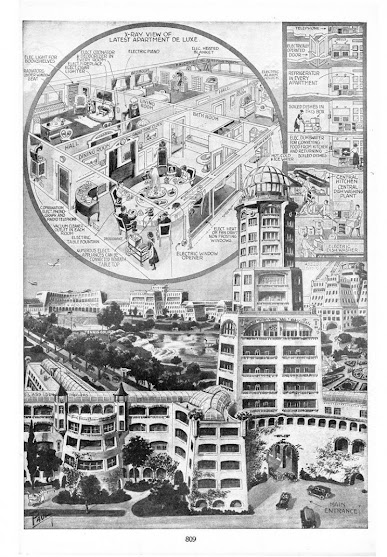
Frank R. Paul from 1920s predicted the apartment of the future.
He got quite a lot of things right, but I can't take my eyes off the water fountain on the dining table (wait, could that be chocolate fountain???).
Dr. Richard Clement Lucas, a surgeon in the early 1900s shared his vision
during a 1911 lecture: “Human beings in the future will become one-toed. The small toes are being used less and less as time goes on, while the great toe is developing astonishingly, and man might become a one-toed race.”
Oh, hell no, Dr. Richard, I need my toes alright. They are useful for gripping rocks in, well, rock climbing or trekking etc, and have you tried picking up something from the floor when your back refuses to bend?
In all seriousness, are we living in a 'dystopian' world now?
We have modern slavery, some are disguised as cultural and economic structure, we face threats of biological and cyber attacks, we are part of meticulous networks with digital footprints of everything we are doing, human rights violations are still and continue to exist. We develop new methods to crack crimes, and crimes evolve to catch up. And to put it simply, even after the rich historical eras, educations, scientific research, many years of study, we are none the wiser; we are still generally hostile and resistant to many obvious things. If it's not apparent, this ongoing pandemic has shown me something that I was ignorant of before: it's not common to have common sense.